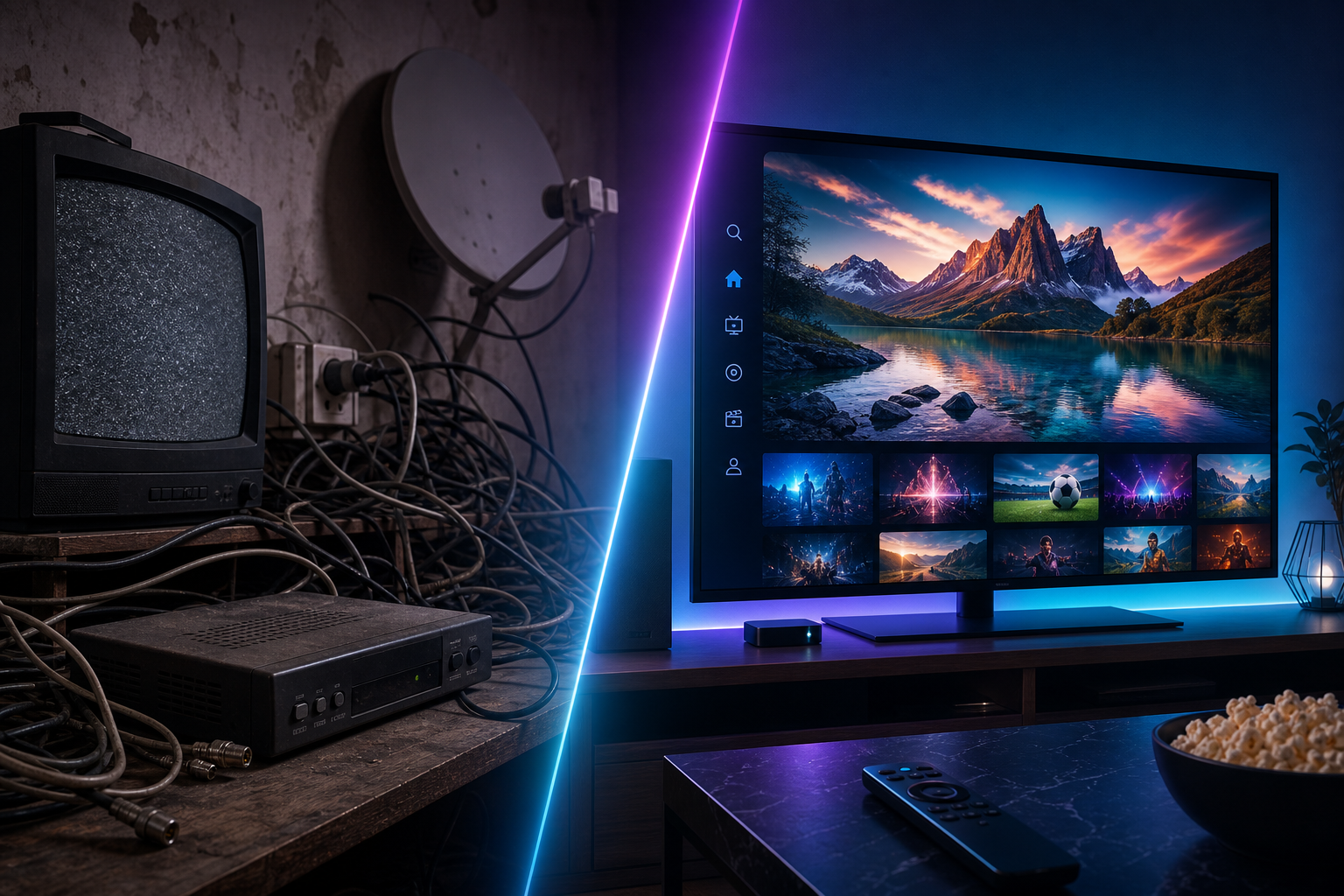
The television landscape has changed dramatically. In 2026, millions of households worldwide are cutting cable and satellite contracts in favour of IPTV — and for good reason.
Not familiar with IPTV yet? Read our complete IPTV beginner’s guide first. This article focuses on the direct comparison: cost, channels, quality, setup, and reliability — so you can decide which is right for you.
What Is IPTV?
IPTV (Internet Protocol Television) delivers TV channels and on-demand content over your broadband connection instead of through a cable wire or satellite dish. You watch on any screen — smart TV, phone, tablet, laptop, Fire Stick, or set-top box — using a compatible app.
Unlike traditional broadcast TV, IPTV is:
- On-demand by design — watch what you want, when you want
- Global by default — access channels from any country in one subscription
- Device-agnostic — works on hardware you already own
Cost Comparison: IPTV vs Cable vs Satellite
| Service | Average Monthly Cost | Contract | Equipment Fee |
|---|---|---|---|
| Cable TV | $80–$180/mo | 12–24 months | $15–$30/mo rental |
| Satellite TV | $65–$150/mo | 24 months | $99–$299 install + rental |
| IPTV (Xstreamity) | $10–$60/total | None | £0 — use existing devices |
IPTV saves the average household $800–$2,000 per year compared to cable or satellite.
IPTV subscriptions like Xstreamity are sold in durations (1 month, 3 months, 6 months, 12 months) with no auto-renewal — you pay only when you’re ready. Cable and satellite lock you into 12–24 month contracts with early termination fees of $150–$400.
Channel Selection
Cable TV: Typically 100–500 channels depending on package tier. International channels are either unavailable or require expensive add-on packages. Local and regional channels are strong.
Satellite TV: 150–900+ channels with slightly better international coverage than cable. Still requires expensive add-ons for most non-English content.
IPTV (Xstreamity): 50,000+ channels from 150+ countries. US, UK, Arabic, French, German, Sports, and dozens of other regional markets — all in one IPTV subscription at no extra charge. News, kids, entertainment, and documentary categories included.
Winner: IPTV — not even close. No cable or satellite provider offers 50,000 channels without multiple costly add-ons.
Picture Quality
Cable TV: HD (1080p) for most channels. 4K availability is limited and usually requires an additional cable box or premium tier. Compression artefacts are common during peak hours.
Satellite TV: Similar to cable — HD is standard, 4K limited. Weather can degrade signal quality.
IPTV: Depends entirely on your internet speed and the provider’s infrastructure. Xstreamity streams in SD, HD, Full HD, and 4K/8K where channels support it. No weather disruption. Adaptive bitrate adjusts to your connection in real time.
Required internet speeds: 10 Mbps for HD, 25+ Mbps for 4K.
Winner: IPTV (assuming a 25+ Mbps connection)
Setup and Equipment
Cable TV: A technician visit is usually required. You’ll need a cable box for each TV (extra monthly rental cost). Setup takes days to weeks to schedule.
Satellite TV: Requires a dish to be professionally installed on your property — cost varies by location. Additional equipment fee, plus a cable box per TV. Not suitable for renters, flats, or homes without a clear sky view.
IPTV: No installation, no engineer, no new hardware. Download a free app on your existing device and stream in under 2 minutes. Xstreamity sends credentials to WhatsApp immediately. See our setup guides for Firestick, Android, and smart TV.
Winner: IPTV — setup is instant, no equipment costs, no waiting.
Reliability
Cable TV: Reliable in most conditions. Outages are rare but do affect whole neighbourhoods and can last hours. Customer service wait times are notoriously long.
Satellite TV: Highly reliable in clear weather, but storms, heavy rain, and snow can disrupt signal completely. Rural coverage is a strength.
IPTV: Depends on your internet connection. A stable 25+ Mbps connection delivers rock-solid IPTV. Xstreamity uses a redundant global CDN with 99.9% uptime SLA. If your internet goes down, IPTV goes with it — unlike satellite, which is independent of broadband.
Winner: Satellite for off-grid/rural / IPTV for urban/broadband households
Catch-Up TV and On Demand
Cable TV: Catch-up and on-demand varies by provider. Often limited to 3–7 days. VOD libraries are smaller than streaming services. Additional monthly fees common.
Satellite TV: Similar to cable — limited catch-up (3–7 days), smaller on-demand library.
IPTV (Xstreamity): 60-day catch-up on supported channels. 200,000+ VOD titles — movies and series — included in every plan with no extra charge.
Winner: IPTV by a large margin.
Portability
Cable TV: Fixed to your home address. Travelling? You lose access.
Satellite TV: Fixed dish — strictly home-only.
IPTV: Fully portable. Watch on your phone, laptop, or travel streaming stick anywhere in the world with an internet connection. Your Xstreamity subscription works on holiday, at a hotel, or overseas.
Winner: IPTV — it goes wherever you go.
Who Should Choose IPTV?
IPTV is the right choice if:
- You want to cut costs without cutting channels
- You watch content from multiple countries or languages
- You have a reliable broadband connection (25+ Mbps for HD)
- You want flexibility — no contracts, cancel anytime
- You travel frequently or live abroad
Consider cable or satellite if:
- Your broadband is slow or unreliable
- You’re in a rural area with no decent internet
- You need local broadcaster support contracts (sports rights, etc.)
Switch to IPTV Today — Try It Free for 24 Hours
Start your free trial on WhatsApp →
No credit card, no commitment. Test 50,000+ channels on your existing devices and see why households are cutting cable. View IPTV subscription plans from $10 →
Not sure yet? Check your internet speed at Speedtest.net to confirm IPTV will work on your connection before committing.